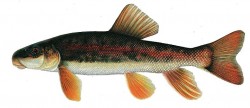
Juvenile quillback carpsuckers on hook and line

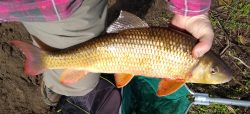
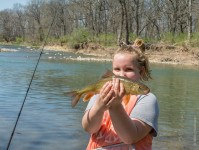
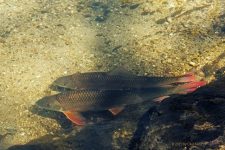
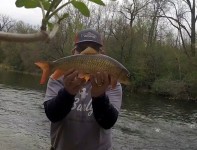
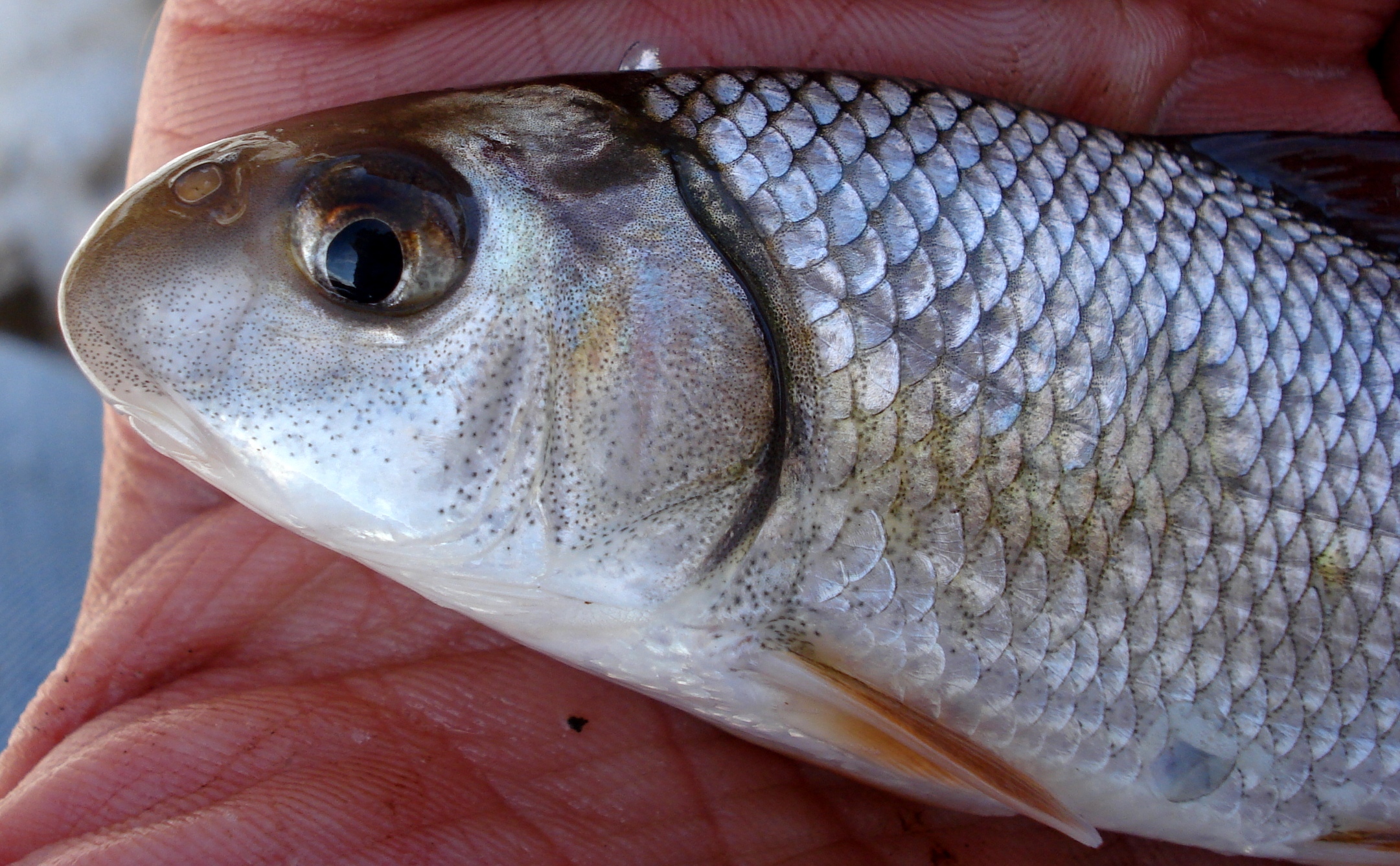
Multi-species angler Ben Cantrell managed to catch a couple of juvenile quillbacks (Carpiodes cyprinus) recently (late March, 2013), and since I have never seen any this young—in person or in photos this clear—I asked if he would let me post them here.

(Edit: Ben has since written up this story on his own blog, along with other fishing successes. Check it out for some great fish and photos: http://bencantrellfish.blogspot.com/)

These were caught in an area of no visible flow in a side channel or small creek connected to the Wisconsin River. Ben estimates the water was 18 inches deep with a temperature of about 40°F.

Ben’s description of his tactics:

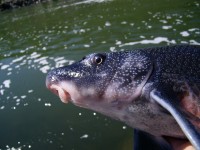
There was a massive school of shiners in the channel, so thick it was difficult to see the bottom.  Every now and then I saw a flash of silver as slightly larger fish on the bottom turned on their sides, which I assumed was feeding behavior.  I was fishing with a Tanago new half moon hook and a tiny bit of nightcrawler.  The shiners would attack the bait before it could reach the bottom, so I put a bigger piece of crawler on (a piece smaller than a pencil eraser).  This allowed the bait to get past the shiners and reach the bottom.  I left the line slack and every 5 seconds gave it a pop to see if a fish was on.  This produced 2 of those juvenile quillbacks in about 15 minutes.  They were both definitely fair hooked in the mouth.  I checked the lower lip for a nipple and did not see one in order to rule out highfin or river carpsuckers.  I suppose it’s possible that juveniles of those species do not have the nipple on their lips.  However, quillback strongly outnumber the other 2 species in the lower WI River, so I’m sticking with quillback.

In fact it is possible for the nipple to be absent from juveniles of the other two species: Etnier and Starnes (The Fishes of Tennessee, 1993, pp. 264-265, full text available online) say of the quillback “This is the only carpsucker that lacks the tiny, nipple-like projection on the lower jaw, but young carpsuckers of other species may have this process absent or weakly developed, and are very difficult to identify.” These are quillbacks, however, based on scale counts. According to Becker (The Fishes of Wisconsin, p. 630, full text available online) the quillback has 36-40 lateral line scales, while the highfin (p. 638) has 33-35 and the river (p. 634) has 34-36. There are about 39 on both of Ben’s fish. There is always the possibility that young specimens of Carpiodes can be confused with young specimens of Ictiobus. Anal fin ray counts can help distinguish the two, but are not available in these photos. Based on their bright silver coloration and general appearance, and on the shape of the suboperculum (symmetrical in Ictiobus, assymetrical in Carpiodes and Ben’s fish), I don’t think there is any need to worry about these being young buffalo.

Ben estimates (based on a measurement of his hand) that these fish were about 5.8 inches long. Given the vagaries of measurement in photos, I’m arbitrarily considering them somewhere between 5.25 and 6 inches (roughly 130 to 150 mm). Becker’s growth chart shows southern Wisconsin young-of-year quillbacks, hatched in May or June, reaching an average total length of 41 mm by the middle of July and 100-110 mm by the middle of September. He writes that “in the lower Wisconsin River, age-I quillbacks are 144 (134-155) mm TL by mid-July; age-II fish average 202 mm.” (p. 632) If Ben’s fish were 130-150 mm long, and if I’m reading the data correctly, they would be products of 2012′s spawn.

Now, let me get to the point. I love fish and fish science, but I am first and foremost a fisherman. Even worse, I’m a fisherman who chooses to pursue suckers. I have to point out the most remarkable thing about Ben’s story:

“This produced 2 of those juvenile quillbacks in about 15 minutes.”

Those who do not target quillbacks may not know that they are generally very difficult to catch fairly because of their extreme skittishness, their preference for small foods (see below), and their ability to suck in and spit out a bait faster than the vibration can travel up the line to the angler’s hand. By the time the signal has traveled from the fish to the hand, then from the hand to the brain and back to the hand as an order to react, the quillback has already expelled the bait. Because of this, quillbacks are frequently snagged outside the mouth when the angler attempts to set the hook. I know fishermen of undisputed skill and expertise who have tried for years, without success, to fair hook a single quillback despite snagging many. That Ben managed two of them in 15 minutes is both remarkable and probably annoying to some others.*

On the subject of quillbacks’ culinary habits Becker writes (p. 632):

The quillback feeds freely on debris in the bottom ooze, on plant materials, and on insect larvae. According to Harrison (1950), only small amounts of indentifiable material are found in the visceral contents: 86% undeterminable debris, 12% algae, and 2% insect remains, with a trace of other invertebrates. Very small tendipedids, sometimes occurring by the thousands, were the only insects found intact in the digestive systems examined. Other insects were represented by larvae cases, detached legs, and wings. In southeastern Wisconsin (Cahn 1927), the quillback’s food consisted of fragments of aquatic vegetation and algae, occasional Chironomus larvae, and a variety of snails (Planorbis, Physa), and small clams.

Thanks to Ben for the photos and information, and for making the rest of us feel like chumps.

The following video shows a feeding quillback (starting at about 2:40, after lots of gar, cats and others) in an aquarium at the National Mississippi River Museum and Aquarium in Dubuque, IA. I keep meaning to go back and get some better quality footage. (http://youtu.be/iuVh2BWmUoQ)

*(Due entirely to dumb luck, and not at all to skill or knowledge, the first sucker I ever caught was a quillback. That was several years ago and despite seeing thousands of them since, and trying every trick in my arsenal, I have never hooked another one.)


Recovery and protection of the Robust Redhorse

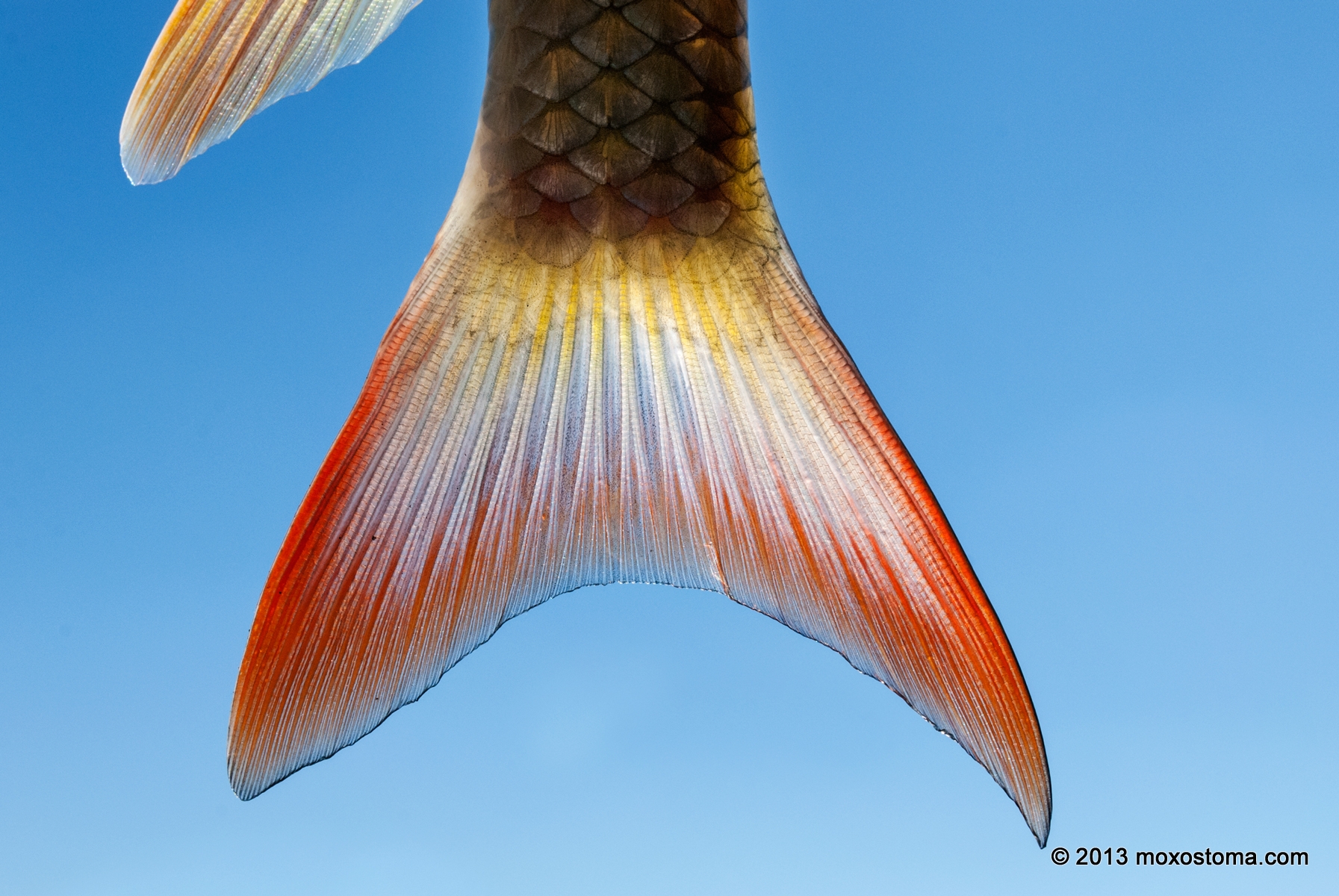
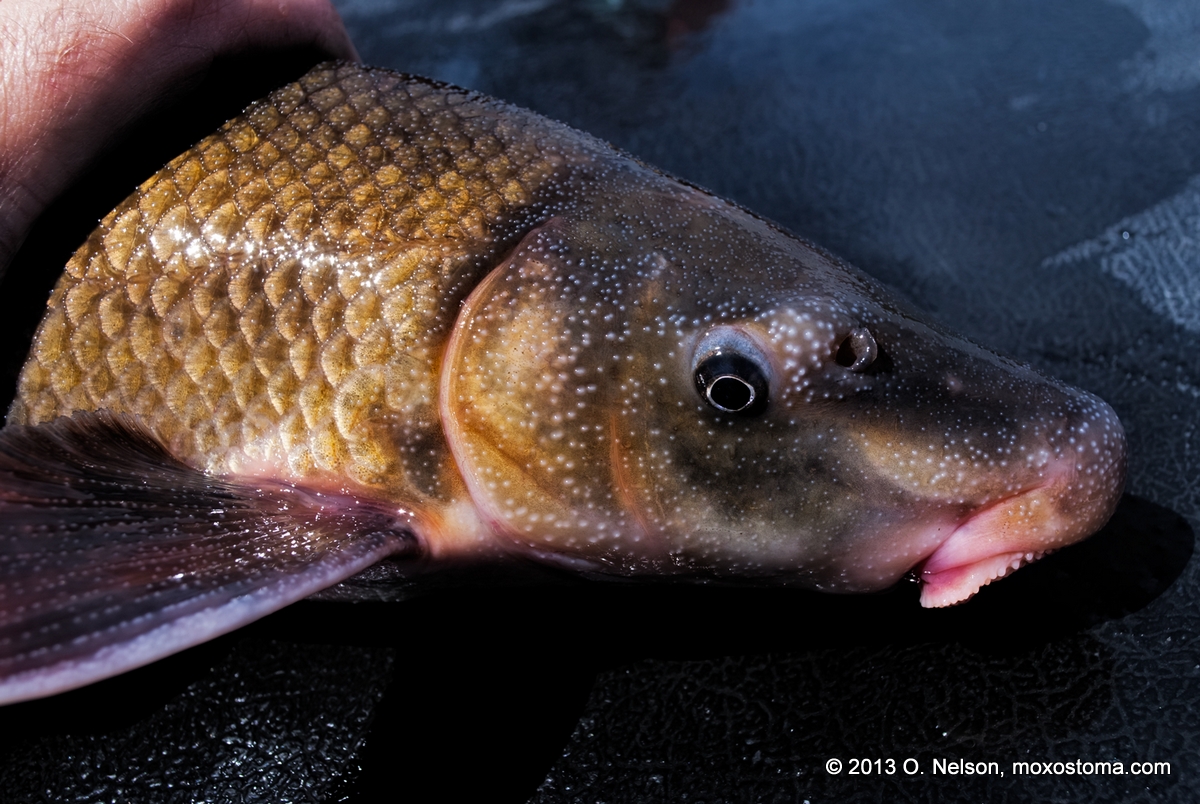
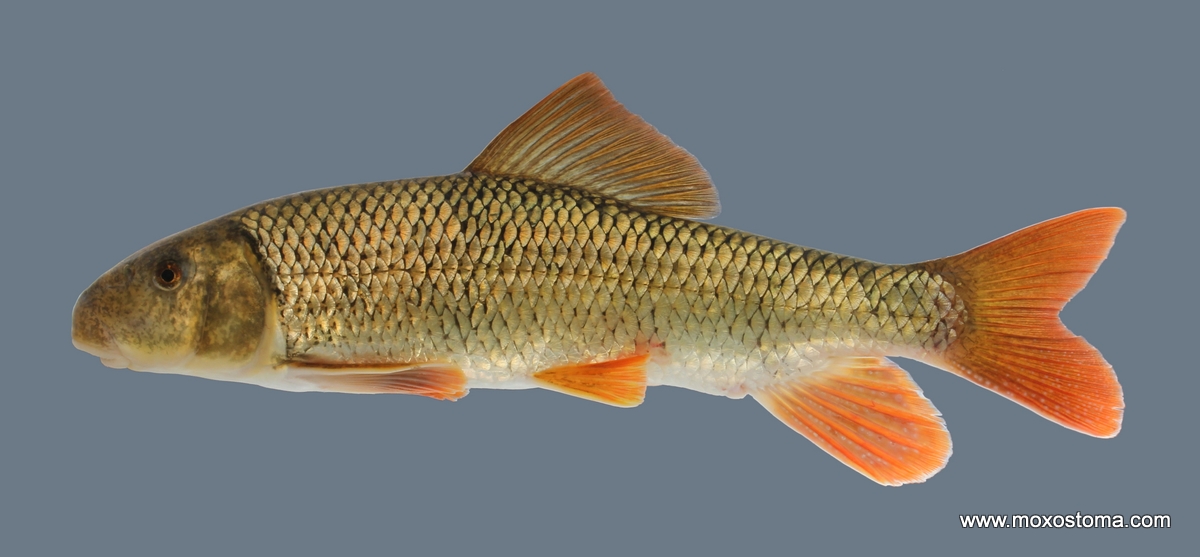
Judging from the photos I’ve seen, and from the gorgeous tuberculate specimen depicted by Joseph Tommeleri (see the factsheet pdf mentioned below), the robust redhorse is an awesome fish. They get big, they live a long time, and they have come back from extinction.

For more on robust redhorse see The Robust Redhorse Conservation Committee website (http://www.robustredhorse.com/) and download their 2 page fact sheet.

This video gives a very brief account of the efforts of the state of Georgia, Georgia Power and agencies of the US government to protect the robust redhorse (Moxostoma robustum) since its rediscovery in the 1980s (after over a century of assumed extinction).


The RRCC site has many good photos, tons of information and a very extensive list of publications about the robust redhorse, including many that can be downloaded as pdfs.

It is unfortunately rare to hear of an extinct species being rediscovered and then helped to survive. I hope the work will continue and the fish will survive both because of that work and in spite of the human propensity to do stupid, short-sighted things with unforeseen consequences. It would be the work of a few minutes in some back room to cancel funding for a project like this. After all, when times are tough and everybody wants something, who really cares about some fish no one has ever heard of and no one spends millions of dollars to fish for?

On the other hand, I’m surprised to find myself—against my better judgment—feeling optimistic. I think the robust redhorse has a chance to survive and maybe even thrive.

Redhorses: Shorthead, Golden, and Silver, and other fish from 2012 so far (tons of photos)

Gallery

Some of the fish I’ve caught in 2012. According to my records, I’ve hooked and landed almost 30 species this year, 9 of which are new additions to my lifelist (sauger, longnose gar, mooneye, silver carp, silver redhorse, yellow bullhead, … Continue reading

Northern Illinois Greater Redhorse, April 2012

How often do you get to meet a new fishing buddy, discover half a dozen excellent multi-species fishing spots within an hour of home, sample the fish resident in those new locations while learning a bit about handling several different types of seines, learn a bit about photo tanks and fish photography, and see and handle dozens of new fish species, including one that’s listed as endangered in the state?

Not very often.

In April I had one of those days when good planning led to an experience that exceeded the daydreams leading up to it. Click here for more, including a bunch of redhorse (and other fish) photos

Flannelmouth sucker, on a fly, in Colorado, in February

I spend a fair amount of time reading about fishing—in books and online—and, as I’ve noted elsewhere on this site, I’m weary of the preponderance of trout writing and trout photos. As I’ve also said, I am a big fan of trout and trout fishing. I just don’t like to see fishing limited to a few types of fish. I’ve wondered if the many bloggers and authors posting amazing trout photos have shots of other fish that they’re not posting in the belief that no one is interested. Then, last month, the guys at False Casts and Flat Tires wrote about the largescale suckers they caught in Montana.

Yesterday this arrived:

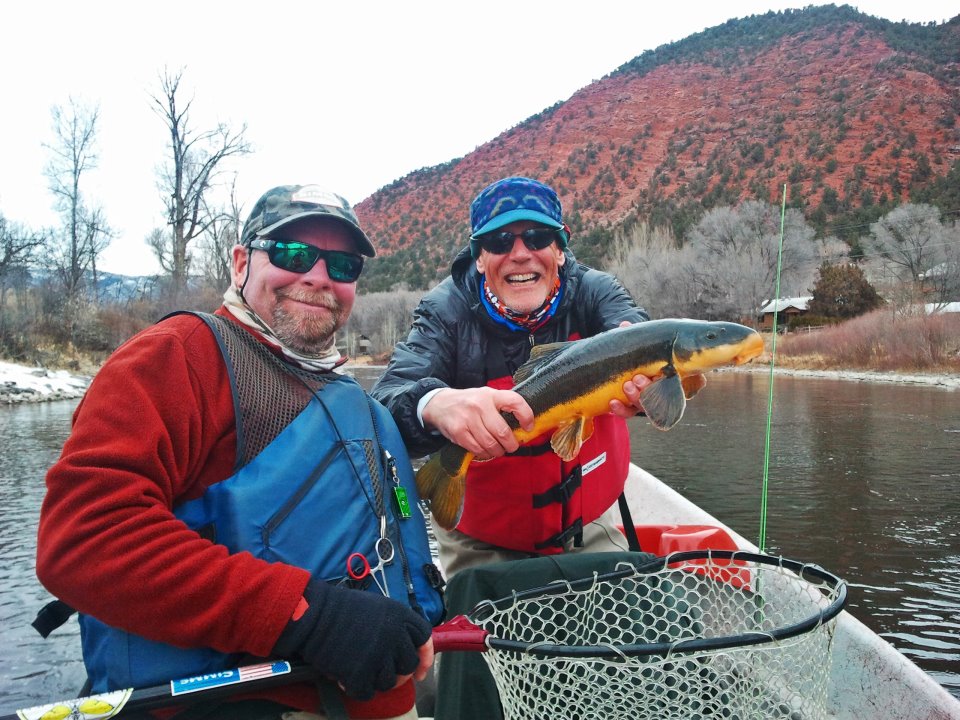
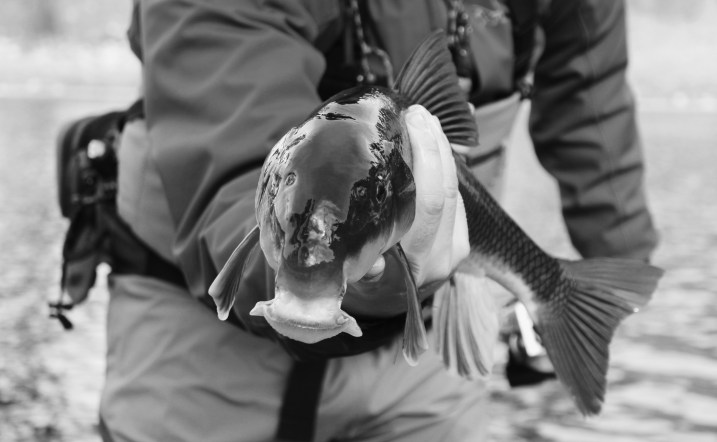
Angler with flannelmouth sucker on Roaring Fork River, Coloradoflannelmouth suckerThe date: Feb. 13, 2012. The place: the Roaring Fork River, near Glenwood Springs, CO. The fortunate angler is Tom Gart and the guide is Kyle Holt of Taylor Creek Fly Shops. The fly: a #18 BH pheasant tail.

The fish: a  Flannelmouth Sucker (Catostomus latipinnis). It is good to see such a healthy-looking specimen, as their range and numbers have decreased due to loss of suitable habitat and competition with introduced species. They are not listed in Colorado, but Nevada lists the flannelmouth as a sensitive species and Utah lists it as being of special concern due to declining population.

The caption accompanying the photo on the Taylor Creek facebook page reads: “We all knew that Tom Gart was a sucker for winter float trips on the Roaring Fork but this is getting out of hand. Thankfully that’s one heck of a sucker! I don’t care what they say, that’s a cool fish! Gotta love the exotics.”

The fish is a native, of course, not exotic, unless by exotic he means “impressive, out of the ordinary, surprising and awe-inspiring.” It is one heck of a sucker.

No word on how Mr. Gart felt about this catch, but I hope he was suitably impressed with himself.

Taylor Creek’s Kirk Webb reports that they catch quite a few suckers. He wrote, “There’s plenty around here….and we all love them as much as the trout.” That’s the kind of attitude I like! If I could afford it, I’d buy a plane ticket and book a trip right now for flannelmouths, blueheads (and an occasional trout).

Thanks to Taylor Creek Fly Shops for permission to post their photo. I asked them to let me know if they find more shots like this. If they do, I’ll post them here. In the meantime, check out their photos on facebook. There’s even another sucker photo among them (not this same sucker).

Taylor Creek’s website is http://www.taylorcreek.com and their facebook page is https://www.facebook.com/profile.php?id=100000439370575

Largescale Suckers on the Fly, Montana, January

The lucky SOBs highly skilled anglers over at False Casts and Flat Tires got a surprise gift from the Bitterroot River recently, and I’m jealous: a bunch of 20″ largescale suckers (Catostomus macrocheilus) and some trout to keep them busy while waiting for another sucker to bite. I can’t go home to Montana and catch fish like these now, so I’m grateful they chose to post excellent photos (and give me permission to post them here). I wonder how many fishing bloggers catch and photograph suckers and other cool fish but don’t bother to post them.

Click these to see them a little larger, but for full effect follow the links below and view them in much higher quality.

Their report: http://falsecastsflattires.com/2012/01/15/fly-fishing-is-for-suckers/

The follow-up with more sucker shots: http://falsecastsflattires.com/2012/01/19/as-requested.

There’s also a video of the day’s fishing, with a little sucker action, at Yukon Goes Fishing: http://www.yukongoesfishing.com/2012/01/cutties-are-for-suckers.html

Jealous. So jealous…

More on C. macrocheilus at fishbase and the Montana Field Guide.

Cowardly pike, sportless walleye, evil gar, holy trout & virtuous whitefish

Looking for Insults

I tend to get pretty angry when I find anti-sucker (and other roughfish) sentiment on the web or in current publications. By now, shouldn’t everyone know better? In older sources, however, I make a point of looking for insults, dismissals, diatribes and condemnations of the fish I like. It’s fun to read. While I wouldn’t expect old books aimed at a popular audience (how-to-fish manuals, fishing guidebooks, memoirs of fishermen) to cover fishing for suckers, the problem is that very few of them ever mention suckers at all, even in passing. (See this post on suckers as vermin for one exception.)

In addition to suckers, I always look to see what—if anything—these authors had to say about some of my other favorites, such as gar and bowfin. As toothy predators from the time before trout, gar and bowfin are easy targets for insults. Like suckers, they are almost never mentioned at all—except in scientific books. I think I’ve found mention of bowfin in only one or two old collections of fishing stories, and I don’t think I’ve ever seen any mention of gar in any old book about fishing.

The scientific books are more fertile ground. Any half decent scientific work of any age that covers the fishes of North America has to include the undesirables I’m looking for, if only briefly, and they usually do it without much entertainment value. The most entertaining prose, unsurprisingly, tends to be in the non-scientific works (see below).

When an author—popular or scientific—feels the need to go beyond simply ridiculing a fish for not being a trout or bass, the usual course is to blame them for harming other, more desirable, species (and it doesn’t matter whether the accusations have merit). Suckers are maligned as mud-eaters lacking esthetic or commercial value, but are also be blamed for eating the eggs of trout and walleye. Gar, bowfin and other predatory fish (other than trout) are blamed for gorging on whatever species are most profitable in a given body of water, be it trout or walleye.

Click here! There’s a LOT more: voracious predators, extermination, prejudice, misinformation, tweed, pipe-smoking, and jack-rocking.

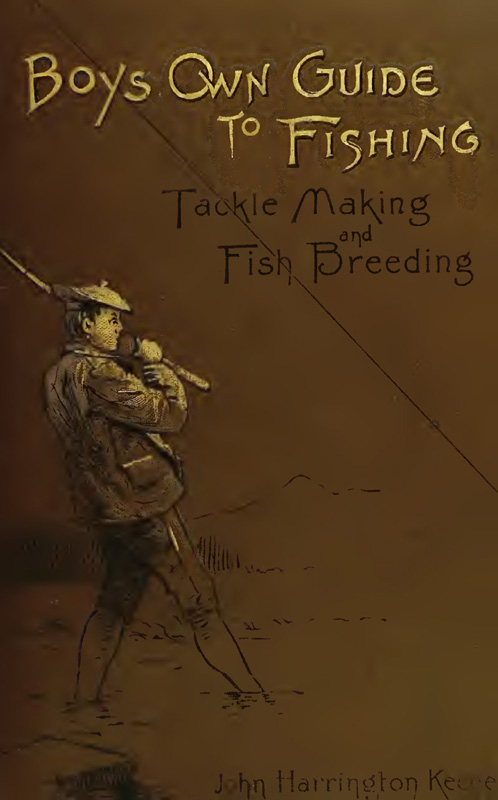
The Boy’s Own Guide to (sucker) Fishing (1894)

Here’s a first: A book that doesn’t malign suckers and doesn’t just mention them in passing or as bait but

  • has an entire chapter about sucker fishing
  • gives suckers pride of place with the first chapter
  • recommends fishing for suckers
  • recommends eating suckers and says they’re as good as trout
  • instructs the reader on proper methods of worm cleaning

There are some slights against suckers, but nothing major and far outweighed by the positives.

Plus, it teaches the proper method of fishing with an unbent sewing needle.

Less important chapters include: Pickerel Trolling in Spring • Bait-fishing for Trout • Fishing for the Sun-fish and other “Boys’ Fishes” • Fly-fishing for Trout and Fly-making • Fly-fishing for Bass, Perch, Sun-fish, etc. • Minnow-fishing for Trout • Bass Fishing with the Minnow, etc. • Fishing through the Ice • Breeding Trout, etc., in Winter

The boy's own guide to fishing, tackle-making and fish-breeding (cover)

Click here to see the whole chapter.